Hypercode Blog, #Consulting
Design & Development in Practice: Presenting Data-Driven Trade Fair and Event Apps at Media University
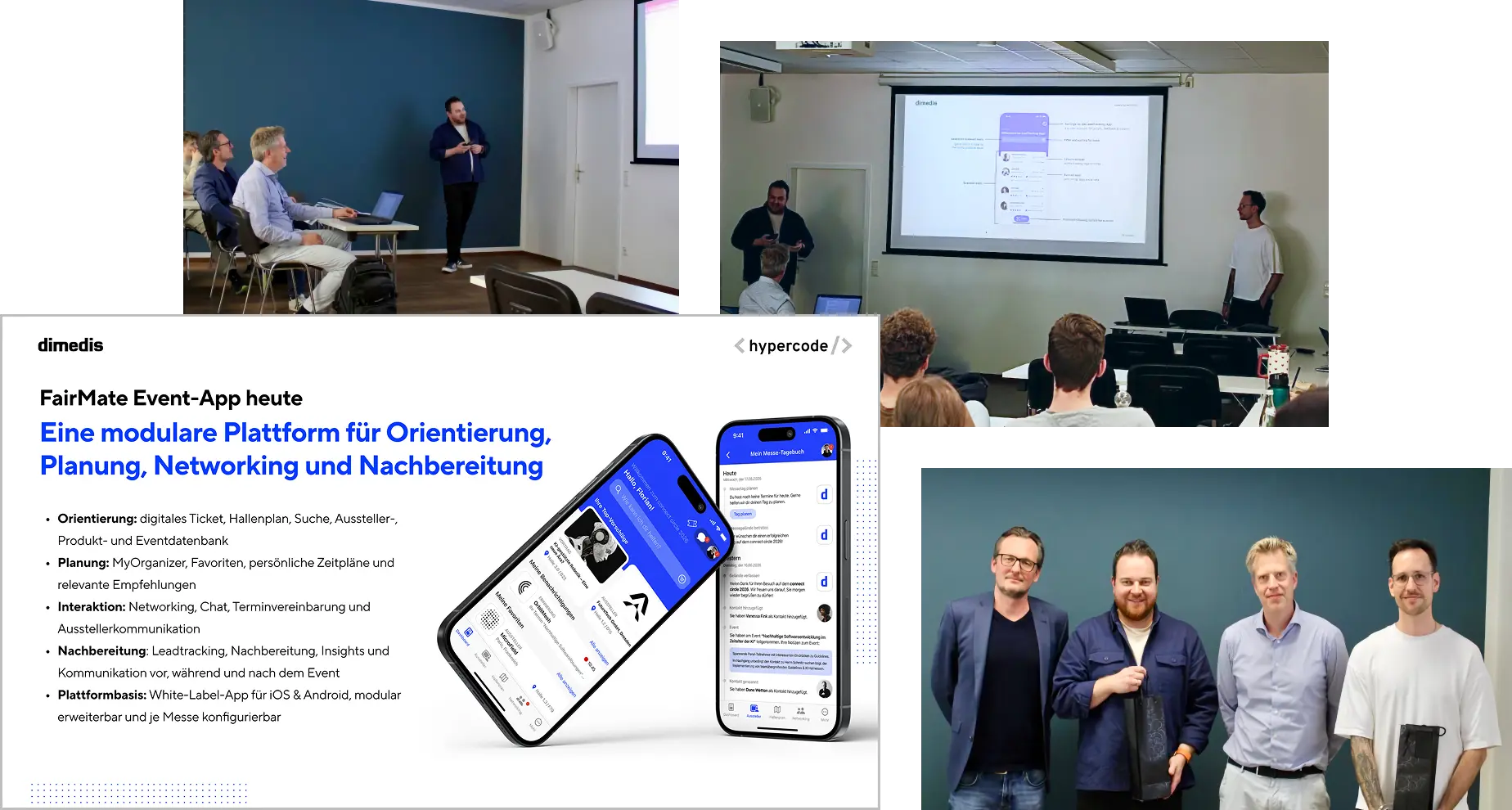
Before the new semester begins, we’re looking back at the previous one. At the invitation of Prof. Dr. Boris Becker, Florian and Stefan shared insights into the collaboration between our companies. Prof. Becker, who has been teaching the “Web Technologies” module with Stefan on the Digital Marketing and E-Commerce program in Cologne for the past two years, welcomed them alongside Prof. Dr. Alexander Rühle.
UX/UI Design and Technology for Trade Fair Visitors
Over an hour and a half, Stefan and Florian showed students how event apps can help people make the most of a trade fair: finding relevant content, navigating the venue and making the right connections.
Using the FairMate Event App as an example, they shared insights into our joint product development process. Hypercode has worked with dimedis as a strategic design and technology partner for several years, from concept development and UX/UI design to development for iOS and Android. The two shared lessons from this collaboration and explained how design and technical implementation work together.
Personalization and AI at Trade Fairs
One focus of the discussion was how content, recommendations and interactions can adapt to individual interests and the situation at hand. Florian and Stefan explained how data analysis can help deliver relevant information at the right moment. They also explored the potential of AI and intelligent matching: apps could suggest relevant contacts and offers, becoming personal trade fair assistants. It’s a topic they also explored in their masterclass at connect circle 2026.
Thank you to Media University and the students for the exchange. We’re looking forward to the new semester!
→ Read Media University’s report on the guest lecture
About Stefan’s Teaching
Stefan has been teaching “Web Technologies” and “User Experience & Web Analytics” at Media University since the summer semester of 2023. He brings experience from our daily work on digital products into the classroom, from the first product idea to the collaboration between design, development, stakeholders and service providers.
connect circle 2026: Female Leadership, Relevant Event Apps and 30 Years of dimedis
This year’s second connect circle was also an anniversary edition: dimedis is turning 30. The opening evening at Pe303 on the Rhine brought that history and the partnerships behind it to life. A summer evening in Cologne, good conversations, a barbecue, ice cream and a great 30th-anniversary party. Congratulations again! 🎉
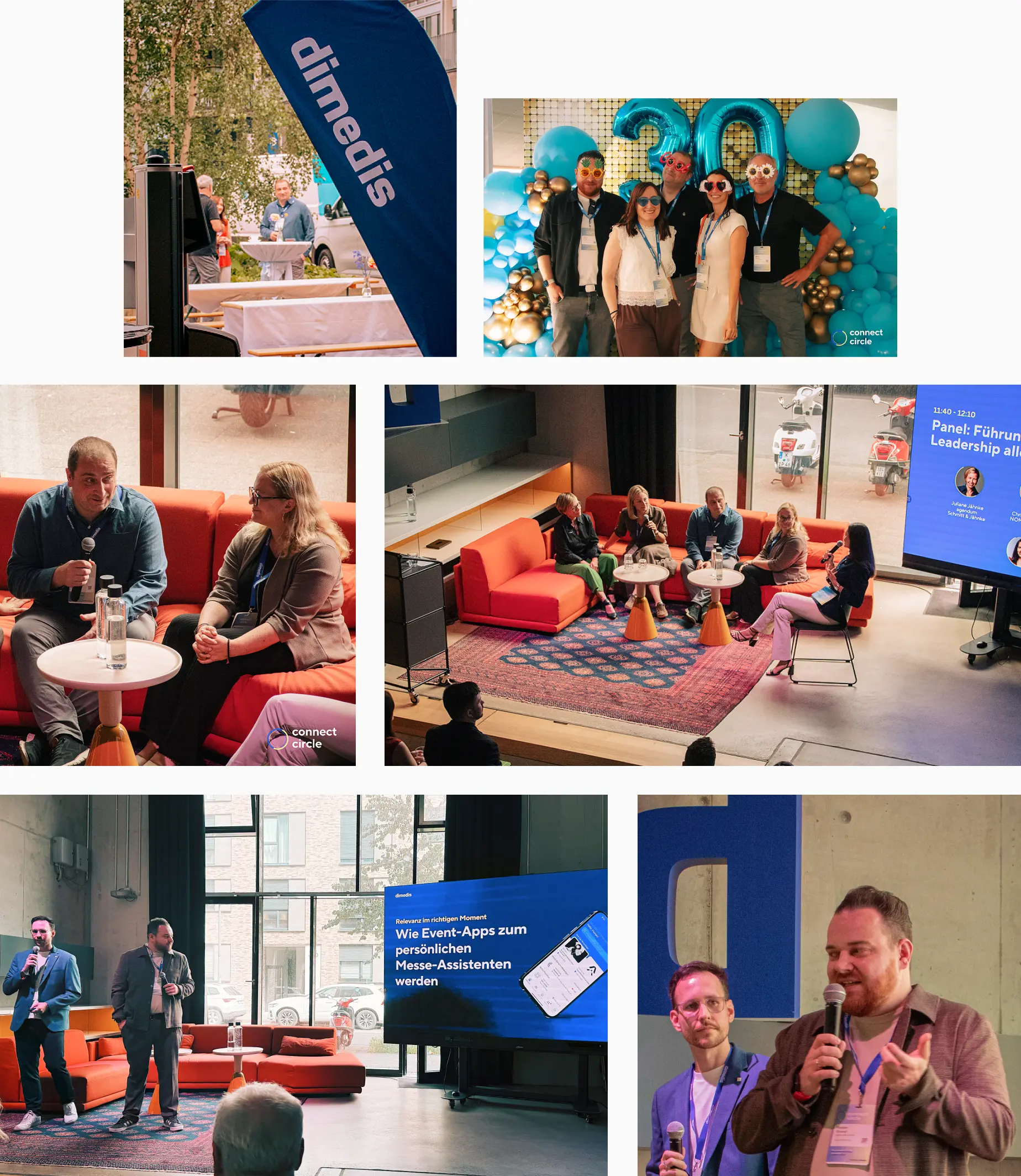
The next day at Clouth Quartier focused on the topics shaping retail, trade fairs and events: commerce media, AI, digital signage, visitor management, measurable trade fair results and how digital services can make a difference on site. Having attended the first connect circle last year, this time we took part in two sessions ourselves.
Panel: “Rethinking Leadership: Why Female Leadership Matters to Everyone”
Our managing director Jens von der Heydt joined Christine Sommer from NOMOO ice cream, Juliane Jähnke from agendum and Konstanze Dallmeyer from dimedis to discuss why modern leadership goes beyond individual career paths. Moderated by Franziska Grabow, the conversation covered structures, visibility, networks and unconscious patterns. It also explored how companies — and, as Jens stressed, men — can help turn good intentions into meaningful change.
Masterclass: “Relevance at the Right Moment: How Event Apps Become Personal Trade Fair Assistants”
Next, Florian Ehle from dimedis and our managing director Stefan Grund showed how apps, including event apps, can become more relevant in the age of AI and hyper-personalization. They shared an exclusive look at the ongoing development of the FairMate Event App, which we build together with dimedis. It already offers much more than a digital program: content is tailored to different audiences before, during and after an event, providing the guidance, information or interaction people need at the right moment.
Thank you to dimedis for two great days and an event that brings industry discussion, product insights and personal connections together so well!
SEO/GEO: Making Websites a Source for AI Search
In our conversations with businesses, we see how quickly AI is becoming part of their workflows, social media presence and digital products. Their websites need to support that direction, too. Content is no longer discovered only through blue links in search results. Search engines, AI Overviews, chatbots and LLM-based assistants interpret it, summarize it and use it in new answers. This is where GEO comes in: Generative Engine Optimization is the practice of preparing content and its structure for generative answer engines.
For us, SEO/GEO builds on the foundations of good corporate websites. A website needs authoritative content, sound technology and clearly defined meaning. It should explain what a business offers, who it serves, the context it works in, and the experience and results behind its claims.
Search engines and AI systems approach this in different ways. They read content, recognize entities and interpret relationships to establish context. Services, people, projects, case studies, articles and contact options therefore need a clear structure as well as an engaging presentation. That means thoughtful information architecture, semantic markup, consistent metadata, a maintained XML sitemap and structured data using JSON-LD and Schema.org. Where useful, it can also include a curated llms.txt file or machine-readable endpoints such as MCP servers.
For CMS websites that have grown over time, this is often an architectural challenge. Custom SEO fields, legacy template logic and inconsistent content models can make it difficult to deliver content clearly. It helps to review existing SEO data, structured data and editorial workflows together, considering how the CMS, frontend, content model and markup work as a whole.
We help businesses develop their websites into dependable knowledge sources for traditional search and AI systems. Our work connects positioning, content structure, the CMS, frontend and semantic markup, looking beyond individual SEO fields.
- SEO/GEO audits of existing website and content structures
- Migration and configuration of SEO systems
- Information architecture for AI-readable service, project and knowledge pages
- JSON-LD/Schema.org for organizations, services, projects, articles and people
- Semantic HTML and technical frontend optimization
- XML sitemaps, canonical URLs and consistent metadata
- llms.txt and curated content summaries for AI systems
- Content structures that support retrieval for chatbots and AI search
SEO/GEO connects our work on Corporate Websites with AI Engineering. A modern company website represents a brand, supports sales and provides knowledge. We build and develop websites with all three roles in mind, so they work well for people and can be reliably understood and linked to by search engines and AI systems.
If you’d like to take your website in this direction, we’d be happy to review it with you, from strategy and content through to the technology behind it.
Hypercode Goes to University: Web Technologies, UX and Web Analytics at Media University
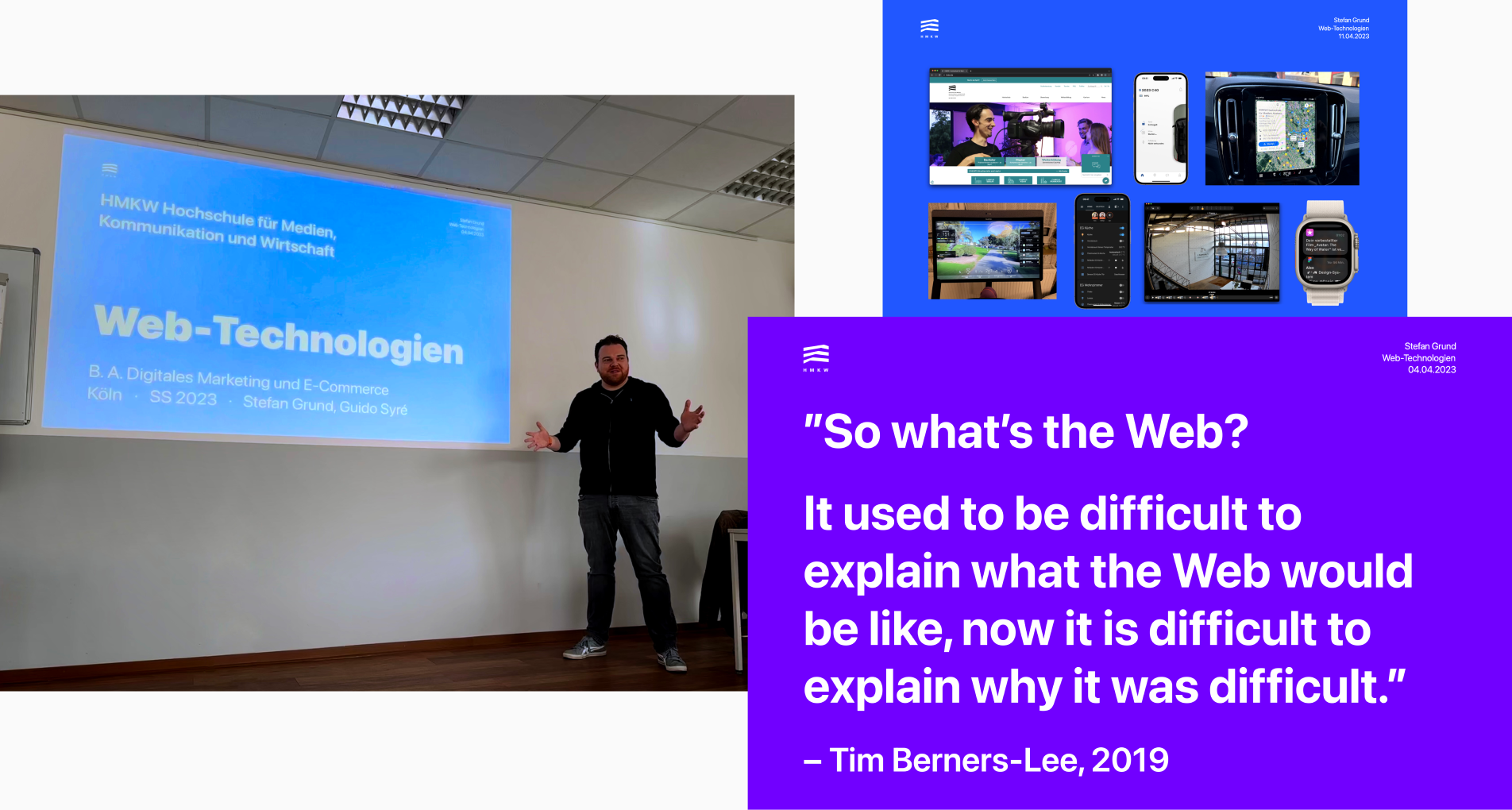
Since the summer semester of 2023, Stefan has been teaching “Web Technologies” and “User Experience & Web Analytics” on the BA Digital Marketing and E-Commerce program, led by Prof. Dr. Klaus Kuenen.
In summer 2023, Stefan and fellow lecturer Guido Syré took students through the development of web technology, from ARPANET and Web 2.0 to Web3 and distributed ledger technologies, alongside the business models behind them. Working with diffferent, the students created a digital business model and concepts for an app and website for an educational publisher. The results were excellent.
For “User Experience & Web Analytics” in the winter semester of 2023/24, our colleague Michael Schulze joined us to cover tracking and analysis. We combined UX design with practical insights, and the students worked with our long-standing client chargecloud to plan an application in the growing field of e-mobility.
This semester, Stefan is looking forward to teaching “Web Technologies” with Prof. Dr. Boris Becker and meeting the new group of students.